
The Environmental Impact of Used Cooking Oil Recycling: Methane, GWP20, and Biodiesel
Used cooking oil is not just a kitchen waste product. It is a carbon-rich organic material. When managed poorly, it can clog sewers, burden wastewater systems, enter landfills, or decompose under oxygen-limited conditions. When collected properly, it becomes a renewable feedstock for lower-carbon fuel.
KEYWORDS: Methane, Biodiesel, Environment, Global Warming, GWP20
- 1 gallon of UCO has a theoretical methane potential of roughly 2.47 kg CH4.
- Over 20 years, 1 ton of methane traps roughly 84 times more heat than 1 ton of C02.
- Which translates to about 3,202,500,000 lbs. of CO2 reduced by Buffalo Biodiesel
in 2025 alone.
Used Cooking Oil Is More Than Waste
Used cooking oil is often treated as a disposal problem, but chemically, it is still an energy-dense organic material. The environmental question is not whether the oil has value; it is whether that value is recovered responsibly or lost through improper disposal.
What Happens When Used Cooking Oil Is Mismanaged?
Sewer and wastewater impacts
FOGs or fats, oils, and grease, are a major contributor to sewer blockages and backups in the home and out in restaurants. When improperly disposed of, FOGs cause overflows and ruin your pipes. That is why is important to never pour them down drains. In order to properly get rid of FOGs it is recommended to cool and contain after cooking. Once it is time to actually dispose of your FOGs while you can send them to the landfill, this has its own set of environmental and economic impacts to consider. Alternatively, we suggest you recycle them so that your waste not only is put to good use, but also protects the Earth.
Landfill and decomposition concerns
FOGs, being organic materials have the potential to do incendiary harm to the broader environment, if treated incorrectly. In oxygen-limited environments like landfills, these organic byproducts can produce incredible amounts of methane which is one of the primary contributors to global warming. The risk exists when organic material decomposes anaerobically, which is the natural process that takes place in a landfill. So, instead of tossing away FOGs consider recycling them. Keeping FOGs out of landfills not only reduces methane production, but it also allows them to be reused as sustainable solutions to energy.
Lost renewable feedstock
When used cooking oil and other FOGs are thrown away, the region loses a recoverable feedstock that could have been used to displace a portion of petroleum-based fuel demand. This alternative fuel has the potential to cut down on greenhouse gas emissions in a big way.
Why Methane Changes the Climate Math
Carbon dioxide is the greenhouse gas most people recognize, but methane is especially important in the near term. Methane does not remain in the atmosphere as long as carbon dioxide, but while it is present, it traps significantly more heat. That is why climate accounting often compares methane and carbon dioxide through a metric called Global Warming Potential, or GWP20.
The Global Warming Potential 20-Year Rule refers to the evaluation of greenhouse gas over a 20-year timeframe, rather than the traditional 100-year timeframe (GWP100). Methane is short lived but a highly potent climate pollutant. It degrades in the atmosphere much faster than C02 (lasting roughly 12 years compared to centuries), but while it is active, it absorbs energy far more efficiently.
- Over 100 years: 1 ton of methane traps about 28 to 34 times more heat than 1 ton of C02.
- Over 20 years: 1 ton of methane traps roughly 84 times more heat than 1 ton of C02.
The GWP20 Impact
Applying the 20-year global warming potential (GWP=84) to these figures illustrates the severe consequences of unmanaged decomposition, such as UCO poured into sewers and landfills.
The CLCPA directs NYS DEC to use carbon dioxide equivalent and the 20-year Global Warming Potential metric, and DEC’s Part 496 uses methane’s GWP20 value of 84.
Why New York Uses GWP20
New York uses GWP20 because the state’s climate framework is designed to evaluate the near-term warming impact of greenhouse gases. When facing a climate crisis the short term is everything. Many know that the Earths systems fluctuate over time and that there have been cooler periods and warmer periods. The concern today is that the warming period is happening at an alarming rate, and for the first time in the Earths history it is being influenced by anthropocentric means. This matters for methane because methane is short-lived compared with carbon dioxide but much more powerful while it is active.
NYS DEC’s Part 496 says the Climate Leadership and Community Protection Act (CLCPA) directs the Department to set greenhouse gases on a common CO2e scale using GWP20, derived from the IPCC Fifth Assessment Report.
The Methane Potential of One Gallon of Used Cooking Oil
**The following is a theoretical methane-potential estimate, not a claim that every gallon of used cooking oil will produce this amount of methane in real-world conditions.
1 gallon of UCO has a theoretical methane potential of roughly 2.47 kg CH4
Using New York’s GWP20 methane value:
2.47 kg CH4 × 84 = 207.5 kg CO2e
207.5 kg CO2e = approximately 457.5 pounds CO2e
Every gallon of UCO that Buffalo Biodiesel is able to divert from the landfill and recycle is equivalent to 457.5 lbs. of CO2 reduced from the atmosphere. To compare, this is the same amount of CO2e created from an automobile travelling every 500 miles. So, for every gallon of UCO collected and recycled, we offset the carbon produced from someone filling up their tank with regular gas.
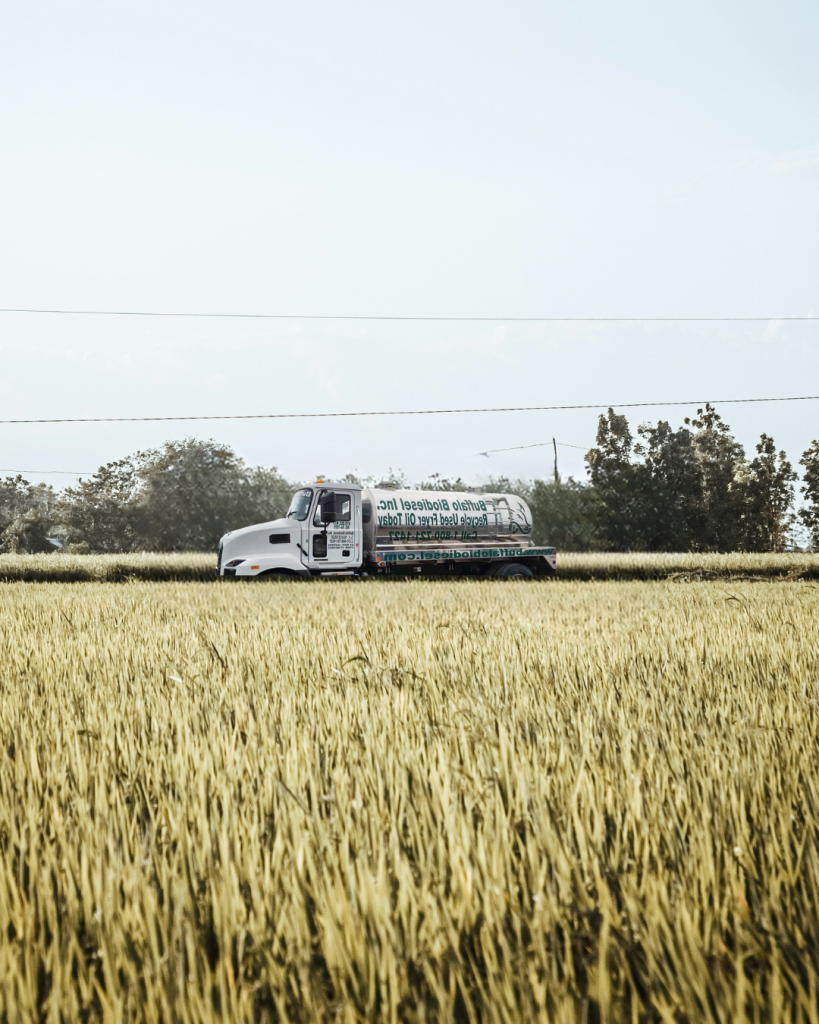
In 2025 alone Buffalo Biodiesel collected 7,000,000 gallons of UCO. That translates to 3,202,500,000 lbs. of CO2 reduction.
Collection Changes the Outcome
The environmental value of used cooking oil collection comes from changing the pathway. Instead of allowing oil to become a waste-management burden, collection moves it into a controlled recycling stream where it can be processed into renewable fuel feedstock. Using UCO collectors like Buffalo Biodiesel ensure your UCO waste gets rerouted.
From Waste Oil to Biodiesel
Used cooking oil is collected, filtered/processed, and converted into biodiesel or renewable fuel feedstock. The U.S. Department of Energy’s Alternative Fuels Data Center states that Argonne National Laboratory life-cycle analysis found B100 biodiesel emissions are 74% lower than petroleum diesel. EPA’s Renewable Fuel Standard lifecycle analysis includes feedstock production and transport, fuel production and distribution, and use of the finished fuel.
Why Local Collection Matters
Local restaurants generate UCO every week. Reliable collection keeps oil out of drains, dumpsters, and unmanaged disposal pathways. A regional collection network reduces waste leakage. Better tracking and service consistency help businesses stay compliant and avoid overflow issues. The more UCO that enters a responsible recovery stream, the more feedstock is available for lower-carbon fuel markets.
The Bigger Picture: Waste, Fuel, and Climate Strategy
UCO collection is one piece in a larger practical climate solution: this is not futuristic, not theoretical, not dependent on new regulation, using the GWP20 we can see how effective biofuels can be in lowering the carbon footprint. Restaurants already generate the material. Trucks already need fuel.
If you are a restaurant or business that disposes of FOGs and want to learn more about how you can not only be a part of this change in helping the planet but get paid doing it, click the button below to speak with one of our team members about UCO collecting with Buffalo Biodiesel today!